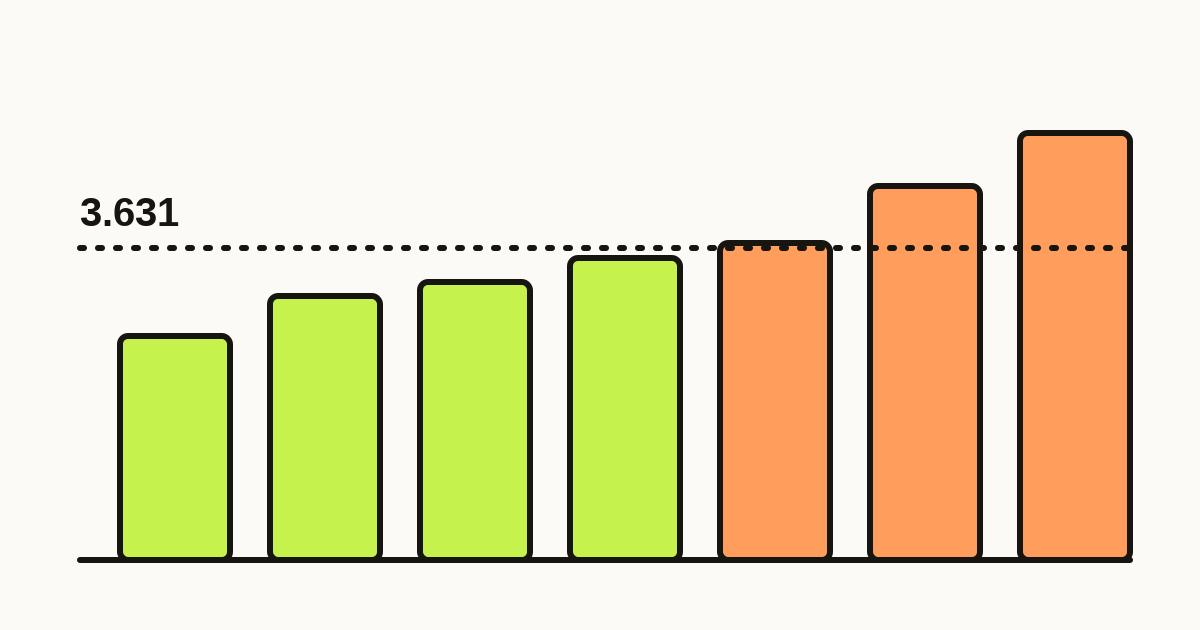
A recruiting agency publishes the salary of a mid-level developer in each country of the region. It goes from USD 3,210 a month in Argentina to USD 4,177 in Brazil, according to Tecla. It is the only source I found that measures them all the same way.
Against the average of the seven countries, USD 3,631 a month, it looks like this:
| Country | USD a month | Against the average |
|---|---|---|
| Argentina | 3,210 | 11.6% cheaper |
| Mexico | 3,403 | 6.3% cheaper |
| Peru | 3,471 | 4.4% cheaper |
| Colombia | 3,581 | 1.4% cheaper |
| Chile | 3,655 | 0.7% more expensive |
| Uruguay | 3,925 | 8.1% more expensive |
| Brazil | 4,177 | 15.0% more expensive |
Yearly average with benefits included, divided by 12, for professionals with working English. Simple average of the seven: USD 43,577 a year. Source: Tecla, undated.
What I do not know about this table
A lot. The agency does not say what sample the figure comes from or what date. And its Argentina page shows the number without a clear label, so I placed it by position.
There is a second source and it does not agree. Another agency, South, gives yearly ranges for a mid-level developer: Peru at USD 16,000 to 30,000, the cheapest of all, and Argentina at USD 40,000 to 60,000, among the most expensive. It is almost the opposite order.
That is why I did not average the two. Differences of a few points, between Colombia, Chile and Peru, cannot be defended as a real difference.
Why the country matters less than it looks
Tools and AI models are paid for in dollars, whatever salaries are worth in the country. The part that changes is labor.
An example of arithmetic, not a quote. If a USD 3,600 build were all labor, 15% cheaper or more expensive would be about USD 540. Between Colombia and Chile, the difference is about USD 75.
And a local provider does not charge the salary in the table: it adds taxes, overhead and margin. The table helps order the magnitude, not predict a quote.
What decides whether it sells is size
A small business pays what the task gives back. With the example distributor, which spends 128 hours a month entering orders, the math gives two ceilings:
| If the system comes out… | Savings a month | Left, before the fee | Maximum build |
|---|---|---|---|
| At half of what is promised | USD 462 | USD 304 | about USD 3,600 |
| As promised | USD 922 | USD 764 | about USD 9,000 |
What is left is the savings, minus USD 80 for the tool, minus USD 78 for an in-house owner. Multiplied by 12 it gives the maximum build. Source: chapter 7 of the book.
A USD 16,000 project like the Peruvian company's does not fit this task. With savings of USD 1,260 a month it took 13 months to pay back, in the best case.
In Medellín, a 2021 quote to a company that handles 16 orders a day came to about USD 9,300 of development and USD 620 a month afterwards, at today's rates. It pays back in 9 months if it comes out as promised. At half, in 43.
That is what an owner sees when the quote arrives. A complex agent with ten integrations does not sell: the small project that pays back within the year does.
How to ask for a quote in any country
- Ask for it in stages, with a pilot on one part of the work.
- Ask separately for the maintenance fee and compare it with your task's break-even.
- Demand the hours math: how many cases a month, how many minutes each.
- Ask how much of the fee is tools and how much is human work.
To run the math with your numbers and your country's hour, use the calculator: it carries each country's employer costs and saves nothing.