In my book's example, entering supplier invoices by hand takes 20 hours a month, and at USD 9 an hour that is USD 180. Keeping a tool and someone responsible for it costs USD 158 a month, on the example's assumptions: USD 80 for the tool and USD 78 for an in-house owner.
That leaves USD 22.
When the task is small, each month's cost barely goes down, and it eats the savings. That is why, in a small business, the first step is not asking for quotes.
What a built project costs
A US rate-card blog (Bet on AI, updated September 20, 2026) gives USD 1,800 to 4,500 to build a complete automation. It says it is based on 54 vendors and does not publish its data, and I do not have a verified equivalent range for Latin America. USD 2,000 barely reaches the floor.
And then comes the monthly fee. An Argentine agency publishes USD 100 to 400 a month for a WhatsApp agent, and a Spanish one, 50 to 150 euros for automating tasks. Each list covers different things, but none says zero.
To pay back USD 2,000 in twelve months, the task has to leave you about USD 167 a month, after the fee. It is the savings minus the fee, not the savings alone.
Four options, cheapest to slowest
- What you already pay for. Ask whoever sells you the till, email or management system whether it already does that task, or which plan includes it. An accounting firm in Trujillo, Peru, used to enter each client's sales document by document. With the import function its system already had, it takes 2 to 3 hours per client, according to the accountant who made the change.
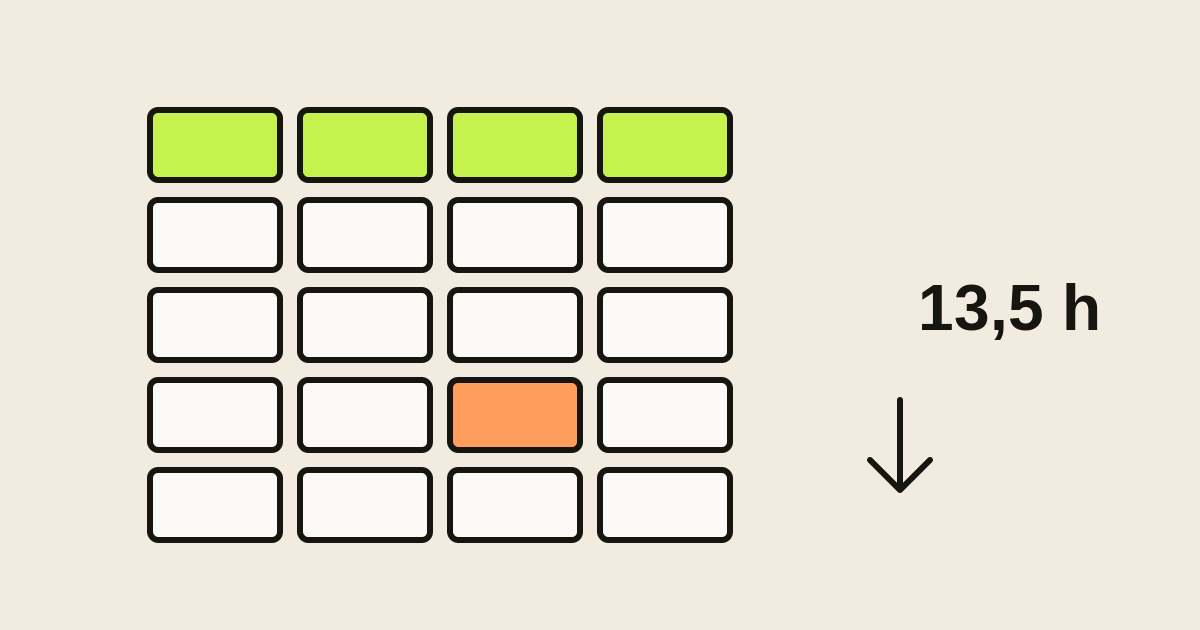
- Tidy the spreadsheet. A restaurant in Chillán, Chile, went from about 30 hours a month (the author's estimate) to 16.5 with a tidied purchasing sheet: 13.5 hours less. The thesis mentions no purchase.
- Bundle several tasks into one project. The tool and the owner are paid once even with three automations, and the freed hours add up.
- Wait. Write down the date and redo the math in six months, with new quotes and your volume by then.
When it does make sense to hire
When the task has volume, or when an hour of your people is worth a lot. With the example's USD 9 hour, 128 hours a month are a USD 1,152 ceiling, and there a USD 3,000 project is worth a serious discussion.
To know which side you are on, the calculator does the math with your numbers. If it says no, the work is tidying up. If it says yes, ask for quotes and start with a pilot.