In Age of Empires you don't advance to the next Age because you feel like it. You need the buildings of the Age you're in and the resources in the bank. Until that exists, the button is off, and you don't argue about it with anyone.
In product there's no button. You can say you're in production whenever you feel like it.
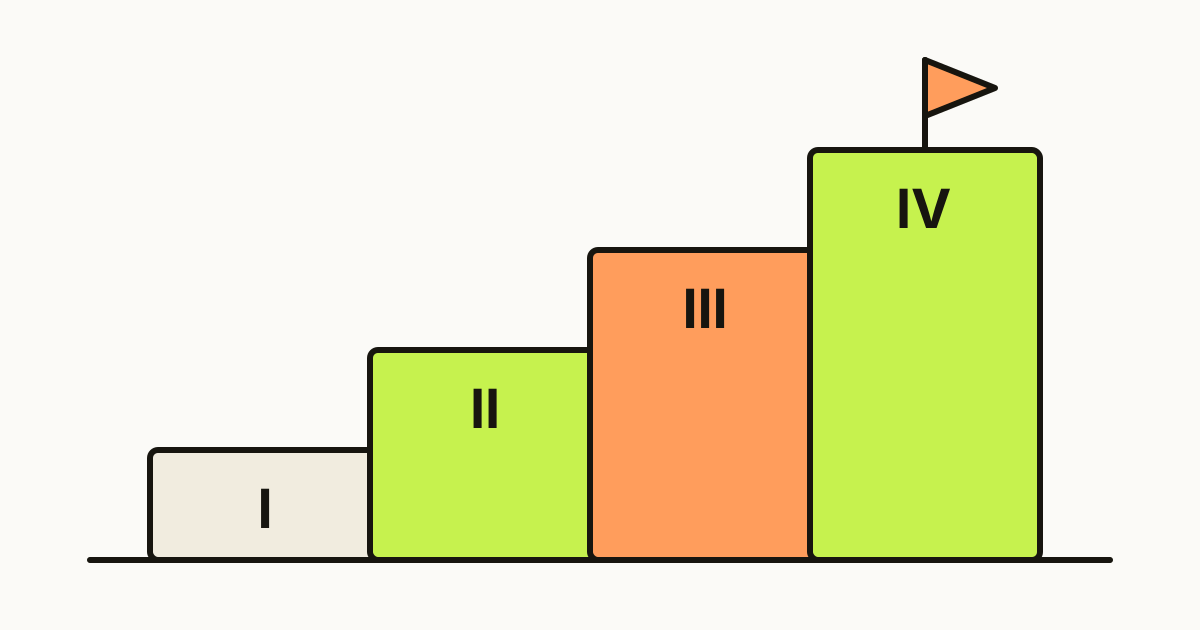
The four Ages of an agent
With agents, there are also four Ages.
| Age | What it looks like |
|---|---|
| Dark | It runs on your machine and you're the one demoing it. |
| Feudal | One real use case, one team, people who know you. |
| Castle | Several use cases, used by people who didn't build it. |
| Imperial | The organization runs on it every day and it can't be turned off without warning. |
The mistake isn't attacking early. That's a decision, and you own it. The mistake is declaring yourself in the Imperial Age with Dark Age villagers: you announce the Age and don't build the economy that supports it.
What you pay for
In June 2025, Gartner said that more than 40% of AI agent projects will be canceled before the end of 2027. The three reasons it gives aren't technical:
- Costs that spiral.
- Unclear business value.
- Inadequate risk controls.
All three are economics. And the distance between saying and having is huge.
- 75%of leaders say they've already adopted agentsForrester, June 2026
- 17%of organizations have agents deployedGartner CIO Survey, 2026
- 11%have agentic systems ready for productionDeloitte, December 2025
Three different measurements, the same year.
A real Age advance
On August 5, 2026, Salesforce announced that the U.S. Department of Defense authorized Agentforce 360 at Impact Level 5. The first deployment is the Army Human Resources Command, which handles more than 1,500 cases per day.
They couldn't before, and it wasn't because of the product. An authorization was missing. That's literally the game's greyed-out button: you don't advance an Age until the controls exist.
The Age-advance checklist
Five boxes, before going to production.
Trace
You can reconstruct what the agent did in a specific run, step by step.
Passes if you can answer why it did that without guessing.
Evaluation
There's a set of cases with expected answers that runs before every change.
Passes if someone can break it on purpose and the set catches it.
Cost
You know what happens to the bill if usage goes up tenfold.
Passes if it's a number, not a look of surprise.
Owner
There's a person who answers when it fails on a Sunday.
Passes if they have a name.
Shutdown
You know how to turn it off and what breaks if you do.
Passes if it's already been turned off once on purpose.
The trap
Rushing is a valid strategy. Lying to yourself about rushing isn't.
What doesn't hold up is rushing while convinced you're booming.